
 I love cooking shows. One of my favorites is the cooking competition “Iron Chef,” in which a challenger competes against a previously chosen champion. The chefs must create a five-course meal in one hour using a ‘secret ingredient.’ At the last minute, the show’s creator, with a dramatic, theatrical flourish, reveals the secret ingredient. The competition points are based on flavor, presentation and creativity in the use of said secret ingredient. Each course, including desert, must contain the secret ingredient, which can be something obscure like Sea Squirts. Often, the secret ingredient sounds incompatible with all of the necessary courses.
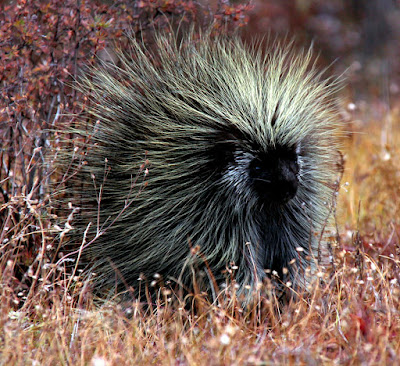
 I just watched an episode where asparagus was served as an ice cream. Asparagus used as an appetizer, deep-fried and adorned with a chip of fried pancetta made me drool, but they lost me on the green ice cream. So now, ladies and gentlemen, I reveal to you the secret ingredient - PORCUPINE!
One of my favorite dishes made by my mother was “Porcupines.” There wasn’t any porcupine in it, only meat balls made with rice in them. The ends of the rice stuck out of the meat resembling the quills of the porcupine. As a kid, I loved the adventurous idea of eating a porcupine, though to date, I have not.
Endemic to the Old and New Worlds, porcupines are the third largest rodents on the planet, coming in behind Capybaras and beavers, which are all edible (I’ve eaten Capybara and it’s delicious). Porcupine is generally only eaten in desperation as it’s fatty and mineraly tasting. The wood pulp, bark and leaves they consume are astoundingly high in potassium imparting that flavor to the meat. One of the reasons they are so destructive is that they constantly seek sodium to offset the potassium they consume. In addition to trees, they eat ax handles, gloves, or anything else that has absorbed salt from sweat.
The word porcupine comes from the French porc d’epine or “thorny pork.” Consistent with the reputation of the pig, the ‘Quill Pig” has a voracious appetite. Because tree parts have less than 2% crude protien, less than most breakfast cereals, porkies have to eat a lot! The greatest wild predator of the porcupine is the Fisher. To avoid the quills, they circle the porcupine repeatedly biting its vulnerable face until it succumbs. A Quill Pig can have 30,000 spines, each with a viciously sharp point and barbed end.
The quills of North American porkies are two to four inches long, but the African Crested Porcupine’s spines are eight to sixteen inches long!
 Long ago, the shafts of birds’ feathers were used as pens called ‘quills’ for their resemblance to hollow porcupine quills. The African porky quill could surely be used as a pen. Porcupines do not throw quills, contrary to popular belief. When threatened, they raise the spines up to make themselves look bigger and will run backwards towards an attacker. Easily loosened from the porky the quills quickly lodge into the attacker’s flesh. Working their way inward at the rate of an inch a day, the quills can be fatal.
There are reports of Great Horned Owls, Ruffed Grouse, deer, bears, pigs, even a trout, and of course, dogs with embedded quills. I have not found reports of any Blue jays with quills, so this one that appeared at my feeders, may be for the record books.
 Omnivorous Blue jays are also hogs of a kind. I have had an enormous flock of 30-45 of them at my feeders this past week. I’ve had to put food out twice a day to keep up with them and they have driven off most of the other feeder birds. To slow them down a little and to amuse myself, I took a whole peanut in the shell and tied dental floss around the middle, securing the end to the feeder. The Jays try repeatedly to take the peanut only to be hauled backward. It doesn’t hurt them, only humiliates them. I wouldn’t hurt them, no matter how much they ate. I wouldn’t hurt a porcupine, either, though they have chewed on my house in the past. However, I do wonder how they would all taste in a savory pie.
A Blue jay kabob with quill skewer - yum!
- Woods, Charles (1984). Macdonald, D.. ed. The Encyclopedia of Mammals. New York: Facts on File. pp. 686–689. ISBN 0-87196-871-1.
- Macdonald (Ed), Professor David W. (2006). The Encyclopedia of Mammals. Oxford University Press. ISBN 0-19-920608-2.


